

Mariano Diaz Rivera
Comisión directiva
Soy psicólogo, investigador en neurociencias y profesor universitario. Estudio la corporización del sistema semántico mediante electrofisiología de superficie e intracraneal y su alteración en cuadros neurodegenerativos.
Investigaciones
8 publicaciónes científicas

Electrophysiological alterations during action semantic processing in Parkinson's disease

Multidimensional inhibitory signatures of sentential negation in behavioral variant frontotemporal dementia
Background Processing of linguistic negation has been associated to inhibitory brain mechanisms. However, no study has tapped this link via multimodal measures in patients with core inhibitory alterations, a critical approach to reveal direct neural correlates and potential disease markers. Methods Here we examined oscillatory, neuroanatomical, and functional connectivity signatures of a recently reported Go/No-go negation task in healthy controls and behavioral variant frontotemporal dementia (bvFTD) patients, typified by primary and generalized inhibitory disruptions. To test for specificity, we also recruited persons with Alzheimer's disease (AD), a disease involving frequent but nonprimary inhibitory deficits. Results In controls, negative sentences in the No-go condition distinctly involved frontocentral delta (2–3 Hz) suppression, a canonical inhibitory marker. In bvFTD patients, this modulation was selectively abolished and significantly correlated with the volume and functional connectivity of regions supporting inhibition (e.g. precentral gyrus, caudate nucleus, and cerebellum). Such canonical delta suppression was preserved in the AD group and associated with widespread anatomo-functional patterns across non-inhibitory regions. Discussion These findings suggest that negation hinges on the integrity and interaction of spatiotemporal inhibitory mechanisms. Moreover, our results reveal potential neurocognitive markers of bvFTD, opening a new agenda at the crossing of cognitive neuroscience and behavioral neurology.

Multimodal neurocognitive markers of naturalistic discourse typify diverse neurodegenerative diseases
Neurodegeneration has multiscalar impacts, including behavioral, neuroanatomical, and neurofunctional disruptions. Can disease-differential alterations be captured across such dimensions using naturalistic stimuli? To address this question, we assessed comprehension of four naturalistic stories, highlighting action, nonaction, social, and nonsocial events, in Parkinson's disease (PD) and behavioral variant frontotemporal dementia (bvFTD) relative to Alzheimer's disease patients and healthy controls. Text-specific correlates were evaluated via voxel-based morphometry, spatial (fMRI), and temporal (hd-EEG) functional connectivity. PD patients presented action–text deficits related to the volume of action–observation regions, connectivity across motor-related and multimodal-semantic hubs, and frontal hd-EEG hypoconnectivity. BvFTD patients exhibited social–text deficits, associated with atrophy and spatial connectivity patterns along social-network hubs, alongside right frontotemporal hd-EEG hypoconnectivity. Alzheimer's disease patients showed impairments in all stories, widespread atrophy and spatial connectivity patterns, and heightened occipitotemporal hd-EEG connectivity. Our framework revealed disease-specific signatures across behavioral, neuroanatomical, and neurofunctional dimensions, highlighting the sensitivity and specificity of a single naturalistic task. This investigation opens a translational agenda combining ecological approaches and multimodal cognitive neuroscience for the study of neurodegeneration.
Methodological considerations for the study of non conscious processes through the masked priming paradigm
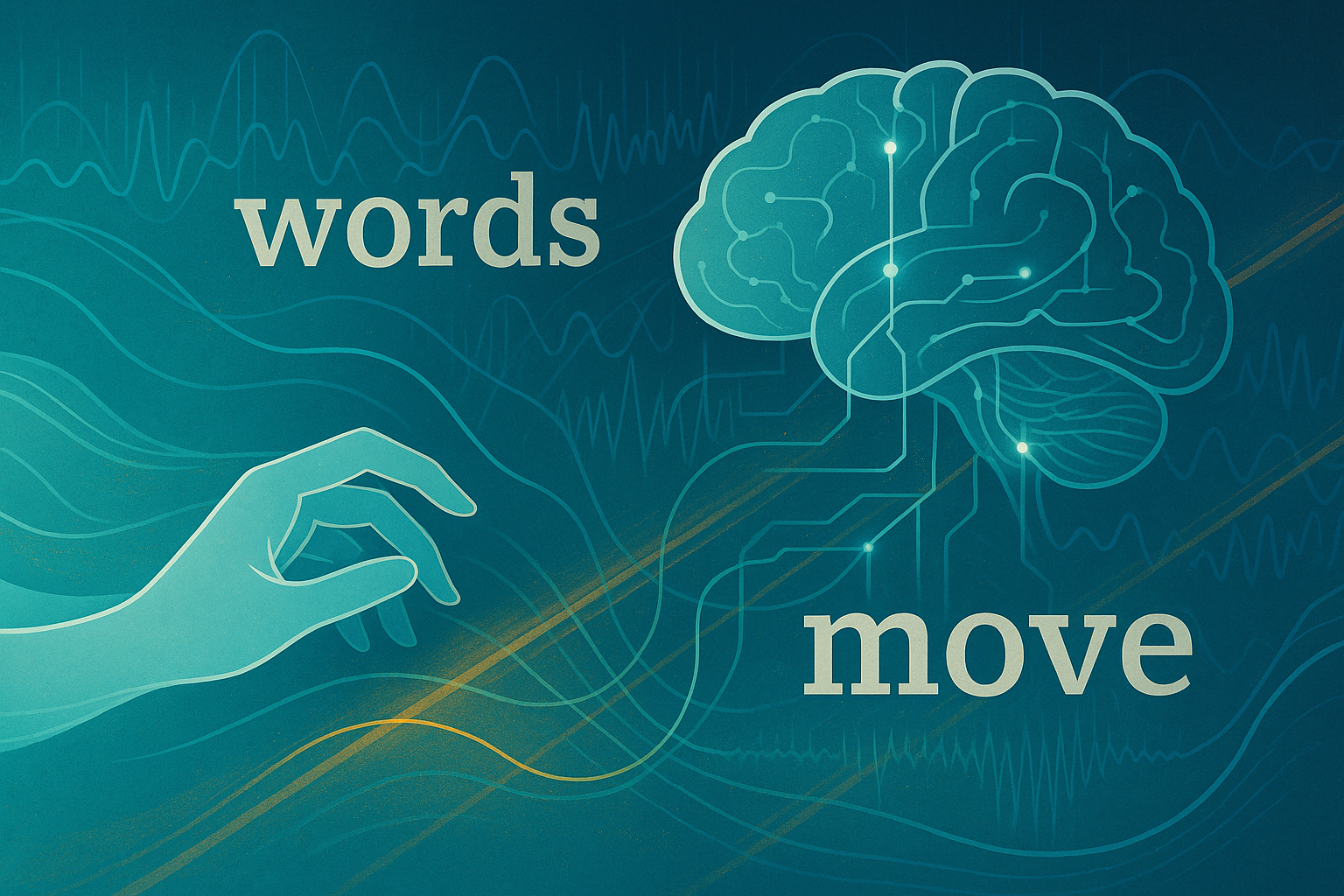
The Neural Blending of Words and Movement: Event-Related Potential Signatures of Semantic and Action Processes during Motor–Language Coupling
Behavioral embodied research shows that words evoking limb-specific meanings can affect responses performed with the corresponding body part. However, no study has explored this phenomenon's neural dynamics under implicit processing conditions, let alone by disentangling its conceptual and motoric stages. Here, we examined whether the blending of hand actions and manual action verbs, relative to nonmanual action verbs and nonaction verbs, modulates electrophysiological markers of semantic integration (N400) and motor-related cortical potentials during a lexical decision task. Relative to both other categories, manual action verbs involved reduced posterior N400 amplitude and greater modulations of frontal motor-related cortical potentials. Such effects overlapped in a window of ∼380–440 msec after word presentation and ∼180 msec before response execution, revealing the possible time span in which both semantic and action-related stages reach maximal convergence. These results allow refining current models of motor–language coupling while affording new insights on embodied dynamics at large.
Language in behavioral variant frontotemporal dementia: another stone to be turned in Latin America
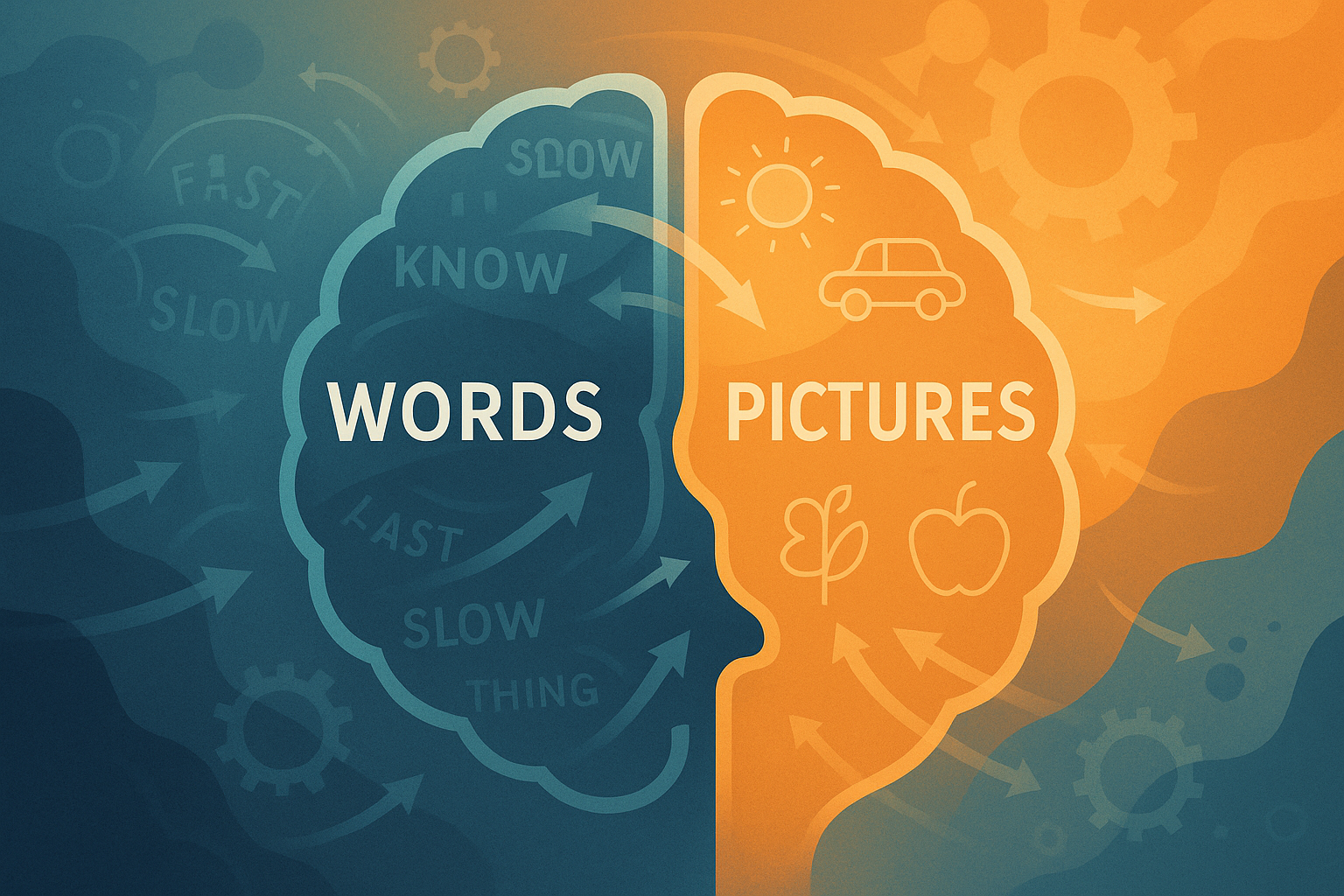
Faster might not be better: Pictures may not elicit a stronger unconscious priming effect than words when modulated by semantic similarity
It has been suggested that unconscious semantic processing is stimulus-dependent, and that pictures might have privileged access to semantic content. Those findings led to the hypothesis that unconscious semantic priming effect for pictorial stimuli would be stronger as compared to verbal stimuli. This effect was tested on pictures and words by manipulating the semantic similarity between the prime and target stimuli. Participants performed a masked priming categorization task for either words or pictures with three semantic similarity conditions: strongly similar, weakly similar, and non-similar. Significant differences in reaction times were only found between strongly similar and non-similar and between weakly similar and non-similar, for both pictures and words, with faster overall responses for pictures as compared to words. Nevertheless, pictures showed no superior priming effect over words. This could suggest the hypothesis that even though semantic processing is faster for pictures, this does not imply a stronger unconscious priming effect.